
Forward Tipping Dumper Licence Training and Ticket Details
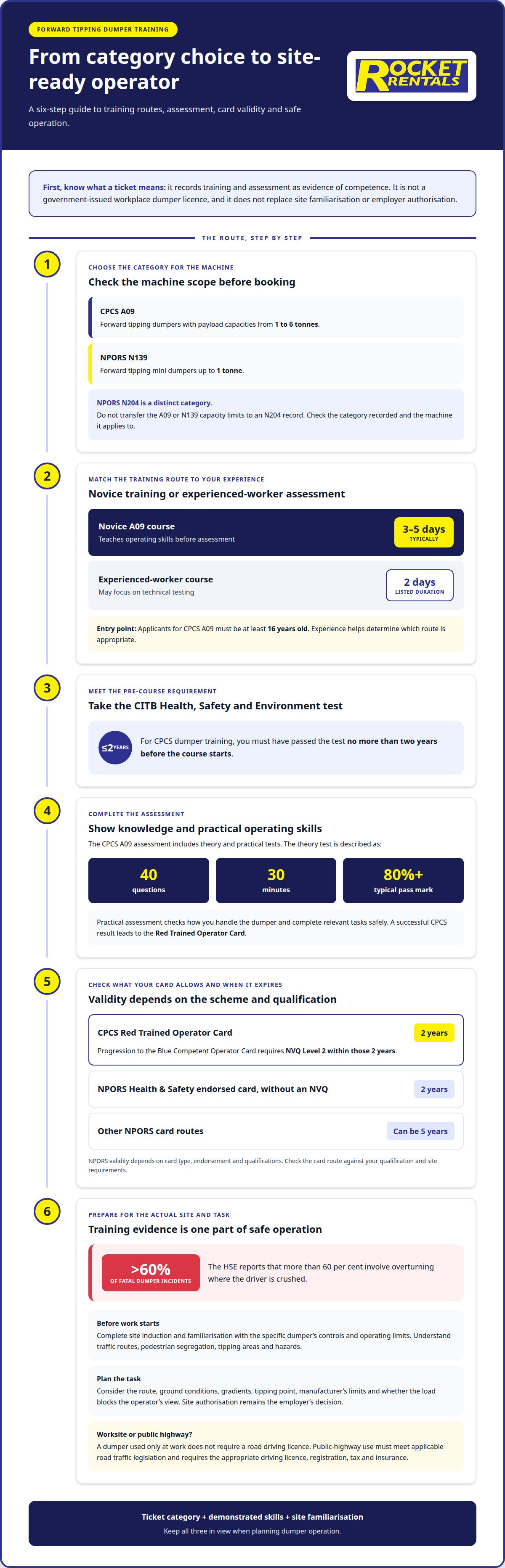
A dumper ticket doesn’t have one universal expiry date. In the UK, there’s no government-issued workplace dumper licence; employers are responsible for ensuring operators are trained and competent. A CPCS Red Card is valid for 2 years, while NPORS card validity depends on the card type and whether you hold an NVQ.
It’s sensible to get a clear answer before booking training or planning site work. Forward tipping dumper licence requirements depend on the accreditation scheme, your experience and the card you need. Understanding what each route covers helps you choose the right one.
This guide explains what forward tipping dumper training and assessment involve, how CPCS and NPORS differ, and what safe operation means in practice. You’ll also find out how ticket validity works and what to consider before taking a dumper onto a worksite or public road.
Table of Contents
What is a forward tipping dumper ticket?
A forward tipping dumper ticket records training and assessment, giving employers evidence of an operator’s competence. Meeting the forward tipping dumper licence requirements also involves site-specific familiarisation and employer authorisation.
Operator training and employer authorisation
Under the Provision and Use of Work Equipment Regulations 1998, employers must provide adequate information, instruction and training to people using work equipment, according to UK legislation. A ticket supports competence assessment; it does not replace site induction, familiarisation or an employer’s decision to authorise a worker. Training should cover practical skills, operating checks and safe procedures for the machine and task.
A novice A09 course typically lasts 3-5 days, while an experienced-worker course is listed as 2 days. The experienced route may focus on technical testing; the novice route teaches operating skills before assessment. After a successful CPCS Red Card, progression to a Blue Competent Operator Card requires NVQ Level 2 within 2 years.
Site and road operation
Site induction explains local traffic routes, pedestrian segregation, tipping areas and hazards. Operators need familiarisation with the specific dumper’s controls and operating limits before work begins. The Health and Safety Executive (HSE) reports that more than 60 per cent of fatal dumper incidents involve overturning where the driver is crushed. Safe planning and supervision matter, especially near edges and on gradients.
A dumper used only at work does not require a road driving licence. If it is driven on a public highway, it must meet applicable road traffic legislation and have the appropriate driving licence, registration, tax and insurance. Site authorisation alone does not permit road use.
Entry requirements
Applicants for the CPCS A09 course must be at least 16 years old. Medical fitness relates to whether an operator can carry out assigned duties safely; employers should consider this alongside training and familiarisation. Age alone does not demonstrate competence to operate a dumper on a construction site.
Your experience helps determine whether you need a novice course or an experienced-worker assessment. Course length varies by route. Before booking, identify the category and assessment route that match the work, and understand what card progression follows a successful result.
CPCS and NPORS accreditation
CPCS and NPORS provide recognised routes for recording dumper operator training and competence. The appropriate category and card depend on the machine and the work.
Health, safety and operator tests
For CPCS dumper training, delegates must pass the CITB Health, Safety and Environment test no more than two years before the course starts. The CPCS A09 assessment includes theory and practical tests, so candidates must demonstrate both knowledge and operating skills.
The A09 theory test is a 40-question examination lasting 30 minutes, with a typical pass mark of 80% or higher. Practical assessment checks how candidates handle the dumper and complete relevant tasks safely. A successful result leads to the CPCS Red Trained Operator Card.
Qualification steps
First, identify the accreditation category that matches the dumper. CPCS A09 covers forward tipping dumpers with payload capacities from 1 to 6 tonnes. NPORS N139 covers forward tipping mini dumpers up to 1 tonne. These category limits help distinguish the machine scope covered by each ticket.
Choose the novice or experienced-worker route that suits you, complete the training and pass the required assessment. CPCS, NPORS and LANTRA are separate accreditation schemes; the scheme name alone does not identify the machine category or card conditions. Employers and construction sites may use training certificates as evidence of competence.
A CPCS Red Card is valid for 2 years. Progression to the Blue Competent Operator Card requires an NVQ Level 2 within that period. An NPORS card’s validity depends on its endorsement and the operator’s qualifications: an NPORS Health & Safety endorsed card without an NVQ is valid for two years, while other NPORS card routes can provide five-year validity. Check the card route against the qualification and site requirements.
NPORS N204 Forward Tipping Dumper category
NPORS N204 is the category name for forward tipping dumper training. Its value lies in matching the operator’s recognised training to the machine and work, rather than treating every dumper ticket as interchangeable. A plant operator should understand which category appears on their record and what machine it applies to before taking on dumper operation.
Category codes matter because similar equipment can sit within different training scopes. For comparison, NPORS N139 covers forward tipping mini dumpers up to 1 tonne, while CPCS A09 covers forward tip dumpers with payload capacities from 1 to 6 tonnes. Those figures describe those categories, not N204. Don’t transfer another category’s limits to an N204 record.
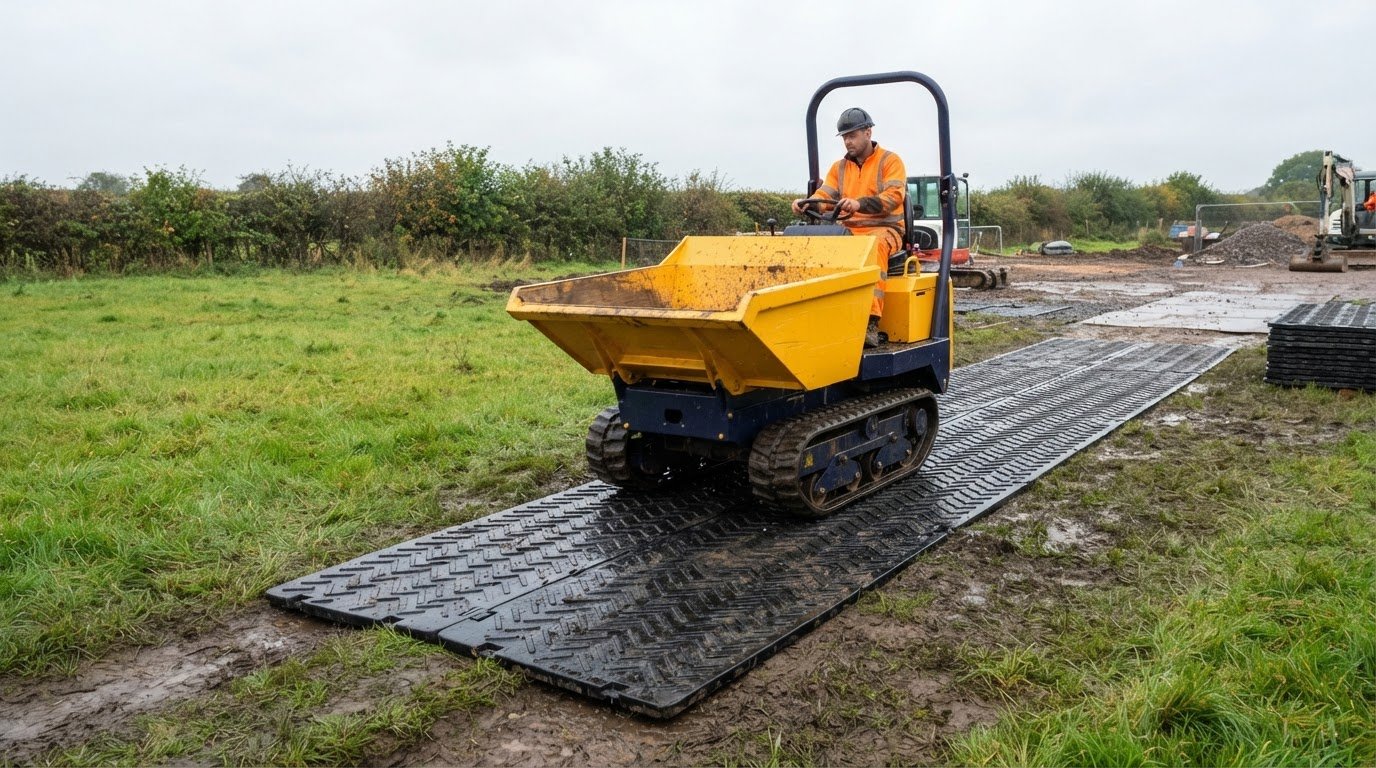
On a construction site, match the category to the machine, its controls and the task. Moving material on firm, level ground, for example, differs from tipping near an edge or travelling on a gradient. Safe planning takes account of the manufacturer’s limits, the route, the tipping point and whether the load blocks the operator’s view. Training evidence supports competence, while site familiarisation covers local routes and hazards.
A useful way to read an N204 qualification is to separate three checks: the category recorded, the machine presented for work and the operator’s demonstrated skills. The category identifies the training route; practical assessment shows the trained operator can handle relevant tasks. Employers can then consider that evidence alongside the site’s operating conditions and authorisation process. A category name alone doesn’t establish competence for every machine or ground condition.
The practical takeaway is specific: treat NPORS N204 as a distinct category, not shorthand for every forward tipping dumper. Keep its scope separate from N139 and CPCS A09, then align the recorded training with the dumper and planned work. This makes category evidence more useful when allocating a plant operator to a machine on a construction site.
What CPCS or NPORS training and tests are required for a forward tipping dumper operator?
CPCS and NPORS training includes theory, practical learning and assessment. The course should match the dumper category and the operator’s experience. Novices learn operating skills before assessment; experienced workers may take a technical test route. Training covers site safety and the steps for operating the machine safely.
For CPCS A09, the theory test is a 40-question examination lasting 30 minutes. The stated pass mark is typically 80% or higher. Candidates need to understand safe working procedures as well as machine operation. This knowledge supports decisions about routes, loads and tipping areas on a construction site.
Practical training covers the manufacturer’s pre-start and functional checks. These help operators establish whether the dumper is ready for work and its controls are working as expected. The practical assessment tests the ability to carry out relevant tasks, not just recall procedures. Candidates must pass the required theory and practical elements.
Safe operation continues after training. Employers should supervise dumper practice, and operators should follow site arrangements for vehicle routes and pedestrian separation. Daily visual checks help identify defects; if a fault affects safety, take the dumper out of service. Training provides a foundation, while site induction and familiarisation cover local hazards and the machine assigned to the task.
Before arranging dumper work in relation to forward tipping dumper licence requirements, match the machine and site task to an appropriately trained operator. If your project needs equipment, arrange dumper hire with Rocket Rentals Ltd for the work planned.
Rocket Rentals: Dumper Hire
Rocket Rentals Ltd is an established, family-run business offering dumper hire on a weekly basis. A dumper helps move materials around your site; operator training and site authorisation are separate from hiring the machine. Equipment inspection checks its safety and condition before hire, helping you plan with confidence to meet your forward tipping dumper licence requirements.
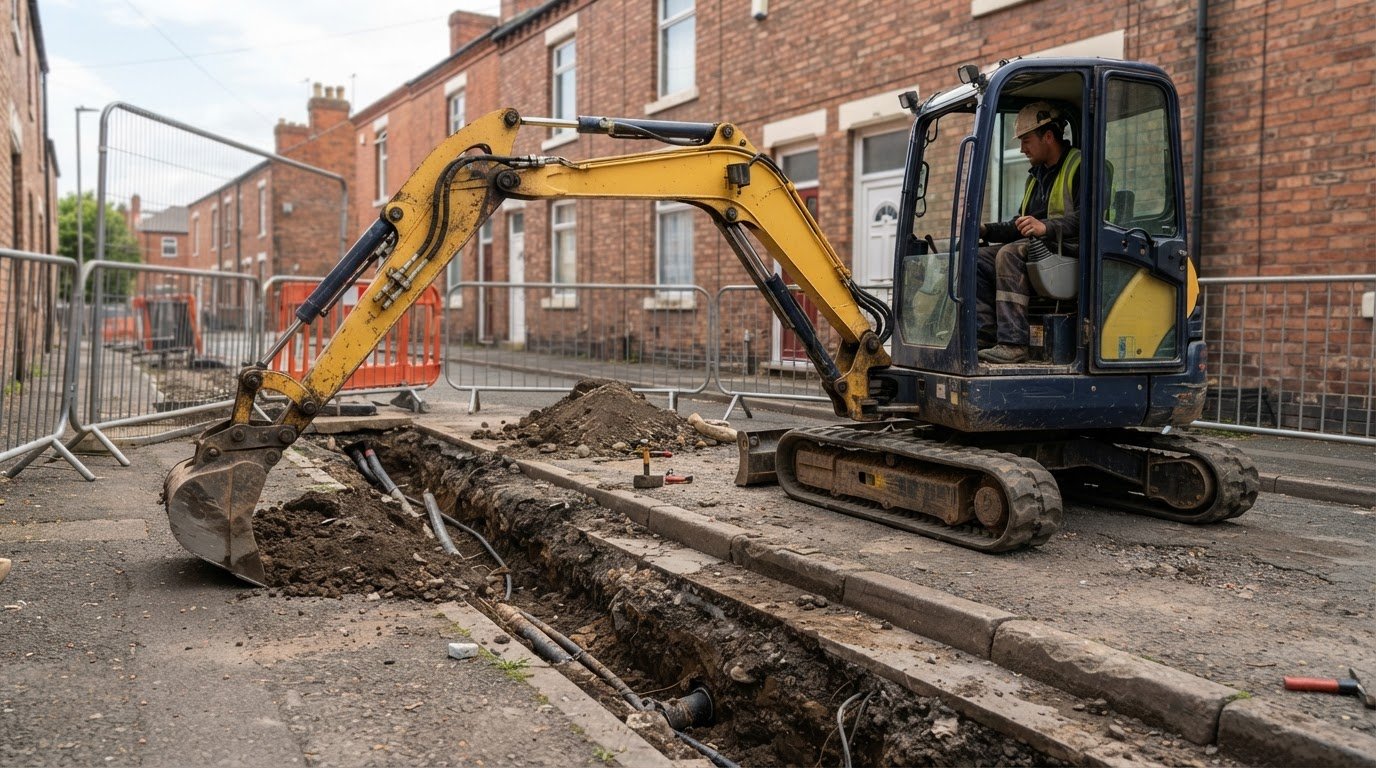
For wider earthmoving tasks, Mini Digger Hire, Excavator hire or Roller Hire may also suit your project. Planning equipment around the work can help coordinate material movement, digging and ground preparation.
Consider the site layout, ground conditions, access and intended tasks when planning equipment hire. These details help determine how the dumper will work alongside other plant.
Contact Rocket Rentals Ltd to discuss Dumper Hire for your project.
Plan your next site move
Use your understanding of forward tipping dumper licence requirements to plan around the operator, machine and site. Before work begins, consider where materials need to go, how the dumper fits into the site sequence and what other equipment the task requires. Coordinated planning helps you organise plant around the work rather than treating each hire as a separate decision.
Plan for delivery access, working space and how the dumper will support the rest of the project. If plans change, review the equipment required and the tasks assigned to each machine. Keeping these decisions connected helps your team organise work efficiently and avoid preventable disruption on site.
For your next project, contact Rocket Rentals to discuss Dumper Hire. A clear outline of the work is a useful place to start, and the right equipment can help you move confidently into the next stage.
Frequently Asked Questions
How long does a dumper licence last?
Dumper cards do not all have the same expiry period. The term depends on the accreditation scheme, card type and qualification route. Check the expiry date on your card and plan any required progression or renewal before it lapses. A workplace ticket is evidence of training, not a government-issued driving licence, so check the card details.
What training do you need to drive a dumper?
You need training and assessment suited to the dumper category and the work you’ll do. The course should help you demonstrate safe operation, rather than relying on general experience with other plant. For example, driving a roller does not by itself demonstrate competence on a forward tipping dumper. Employers should also consider whether the operator can perform the assigned task.
Which dumper course should you choose?
Choose a course that matches your experience and any additional duties involved. For example, an experienced-worker course combining CPCS A09 forward tipping dumper and A31 ride-on roller is listed as 2 days. A foundation or novice course combining A09 with A73 vehicle and plant marshalling is listed as 5 days. These options suit different training needs, not interchangeable tickets.
Who should attend?
Anyone assigned to operate a dumper at work should receive training suited to the machine and their duties. This applies to workers who drive a dumper as part of a broader construction role, as well as dedicated plant operators. Employers should consider the tasks, site conditions and operator’s experience when arranging training and assessing competence.
What does an employer need to check?
Employers should consider the dumper’s condition and how the task will be controlled, as well as training records. Check, for example, that the load does not block the driver’s view, seatbelts are used and wheel stops are safely positioned when tipping near an excavation edge. The dumper must be suitable for its intended use and kept in a safe condition.
What happens after you pass the CPCS dumper tests?
Passing the tests records your achievement and begins the next stage of workplace competence. Keep your card details accessible for work assignments and training records, and make sure the task matches the category you were assessed on. Employer authorisation and practical familiarisation with the machine and task are still essential before you operate on a particular site.

Comments